
Support us >
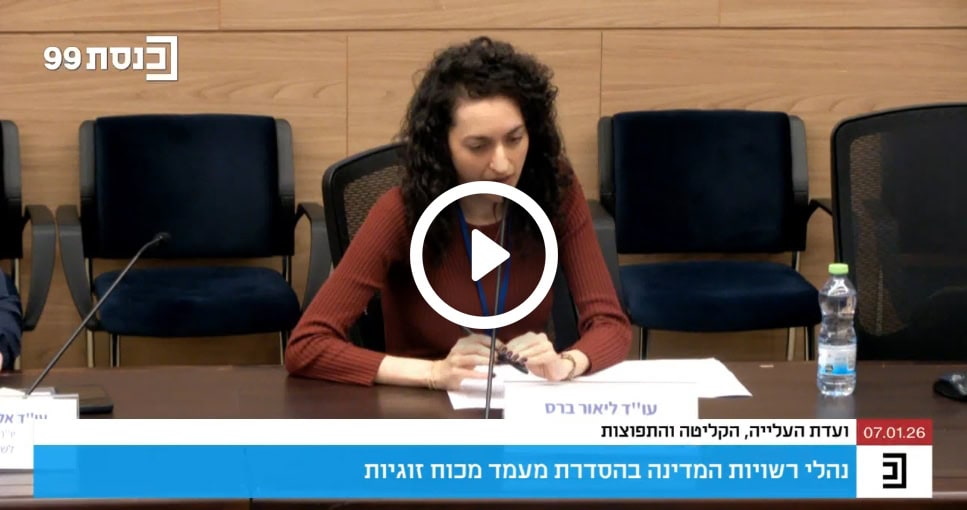

Last Wednesday, January 7th, the Immigration and Absorption Committee convened for a follow-up discussion on the procedures for regularizing status for partners of Israelis. This discussion followed the initial committee meeting held in November at AIC’s request, and was again held in close cooperation with AIC and its chairwoman, Adv. Lior Beres.
While the November discussion served largely as an introduction to the systemic failures of the partner visa process, this meeting was intended to move the conversation toward practical solutions. Although no concrete policy changes were finalized, the discussion marked a shift toward more focused, substantive engagement with the issues raised by AIC.
As background to the discussion, PIBA submitted its official response to the committee’s requests only on the morning of the meeting itself. The response letter, signed by the Head of the Population Administration, Mr. Yoel Lipovitsky, addressed several demands raised during the November discussion and a number of proposals put forward by AIC to make the process more efficient:
- Regarding the request for data on waiting times from the submission of an application until the granting of an initial partner visa (B1 or A5), PIBA made the excuse that extracting such data is too technically complex and would require manual review of thousands of files. They only shared information about average time to get an A5 visa, which was less relevant for our focus.
- PIBA rejected the proposal to extend visa validity throughout the gradual process from 12 months to 18 months, stating that it sees no justification for such a change.
- On the issue of non-Israeli partners waiting in Israel on a tourist visa while their application is processed, our arguments were accepted and PIBA announced that a protocol update is expected soon, which would allow partner of Israelis who received visa (including tourist visa) as a part of the immigration process, to receive an entry visa (more details to follow, stay tuned!).
- Regarding applications submitted by couples residing abroad, PIBA acknowledged the double processing between embassies and its offices in Israel, but did not propose any solution or address the impact of this situation on the couples affected. They excused the inefficiency as a result of the lack of a system for data transfer from embassies.
- With respect to the Nativ procedure applied to couples from former USSR countries, PIBA asserted its authority to consult with Nativ but did not address the requirement for couples to attend in-person meetings in Jerusalem, nor the fact that the Nativ questionnaire is available only in Russian.
- Finally, regarding the long-term tourist status of partners of Israelis residing abroad, PIBA stated that a protocol update concerning visiting procedures for married international couples will be published soon, without addressing our request for longer-term stays that aren’t simple visits.
In preparation for the meeting, the Israeli Bar Association also submitted a position paper. In contrast to PIBA’s response, the Bar Association supported most of AIC’s proposals, criticized the unjustified suspicion directed at international couples at border control, and called for a fundamental change in entry policies. AIC expresses its appreciation for the Bar Association’s support and its recognition of the systemic problems faced by international couples.
Watch the full session of the discussion on our Facebook Page:
During the discussion itself, Committee Chair MK Gilad Kariv opened by placing strong emphasis on what he described as the “first leg” of the process—the period between submitting an online application and receiving an initial, non-tourist status. MK Kariv accurately referred to this stage as a “wild west,” criticizing PIBA for treating it lightly despite its severe impact on couples and families.
MK Kariv then turned to the situation of Israeli–international couples residing abroad, a subject he considers important due to its implications for negative immigration and the return of Israelis to Israel. Echoing AIC’s long-standing position, he stated that it is unacceptable for couples who apply at an Israeli embassy to be forced to restart the process from scratch upon entering Israel together. He urged PIBA to find a solution and reiterated that, at a minimum, the non-Israeli partner should be allowed to work. He also asked PIBA to consider allowing couples to submit online applications while still abroad in order to shorten processing times once they arrive in Israel.
Addressing PIBA’s failure to provide data, MK Kariv was unequivocal: data must be presented. If system-wide extraction is not possible, he suggested conducting spot checks at selected offices to establish a factual baseline.
Anticipating this issue, AIC arrived prepared with independently collected data. Adv. Beres presented findings from a survey conducted within AIC’s Facebook community in the week preceding the discussion. According to the survey, 83% of unmarried couples reported waiting more than four months for a B1 visa, with 60% waiting over six months. Among married couples, waiting times were somewhat shorter due to the absence of an interview requirement, yet still significant: 43% received a B1 visa within two months, while 50% waited over six months. AIC emphasized that such delays are unacceptable and must be addressed. MK Kariv agreed and asked PIBA to define an administrative standard for what it considers a reasonable waiting time.
The discussion then returned to the immigration process for couples residing abroad. AIC explained how both PIBA’s response letter and the Ministry of Foreign Affairs’ statements demonstrated unnecessary duplication of bureaucratic work, and how current policies effectively penalize couples who follow official procedures. AIC stressed that Ministry of Foreign Affairs staff already conduct interviews and review documentation, and that their professional capacity is sufficient. At the very least, AIC argued, a B1 visa should be granted at the embassy stage.
Finally, the committee addressed the Nativ procedure. On this issue, AIC’s position received partial validation: a Nativ representative announced that the questionnaire would be published in English within ten days. Regarding the requirement for a Nativ meeting, MK Kariv proposed a compromise in the form of an online meeting. Adv. Beres objected to this solution, as well as to any additional processing by Nativ, arguing that it constitutes unjust discrimination against citizens of former USSR countries. AIC reiterated its position that PIBA may consult with Nativ internally, just as it consults with the Ministry of Foreign Affairs, but that there is no justification for imposing additional procedural burdens on couples themselves.
At the conclusion of the discussion, MK. Kariv outlined several next steps aimed at improving the efficiency of the partner visa process. These include renewed demands for concrete data on waiting times, particularly during the “first leg” – from the submission of online applications to the granting of initial status; a policy review, together with the Ministry of Foreign Affairs, regarding the possibility of granting Israeli–international couples who apply from abroad work visas at the consular stage. The committee also asked PIBA to examine the prolonged period during which common-law couples remain on B1 status – describing its current length as concerning – particularly in light of its impact on access to state health insurance. In addition, the chair called for a review of the scope and format of the Nativ procedure. These issues will be revisited in the upcoming discussions.
We wish your kind words of appreciation were enough! But our advocacy, legal work, and engagement with policymakers demand consistent resources. Becoming a monthly donor helps us continue this work. Even 10₪/month go a long way!